Tuesday, December 9, 2008

Final Project: Cotton Spiral

REMEBER TO CLICK ON PICTURES TO MAKE THEM LARGER...it is hard to see a lot of the detail in the pictures unless you make them bigger.


My final project, which I named Cotton Spiral was made with toothpicks and cotton twine. In some places, I found the ground to be too hard to put the toothpicks in or too soft. I had to feel out the few areas that would hold it. I started at the center of the rock and spiralled outward. Each ring was a little wider until I got to the tree.

As I was making this project many people passing by and neighbors stared at my strangely. I noticed the people living next door seemed concerned. I hope they were not mad. Construction workers stared and thought what I was doing was pretty funny. I didn't have to explain myself though, so that's good.

I left the project there, we will see how long is stays up. I'm sure someone will take the toothpicks out of the ground soon. But that is how Earth Art is, evolving. I had a lot of fun doing this and would like to do another project like this on a larger scale with different, more noticeable materials. I'm a design student and really love typography and felt this project was a great outlet for this. It was great to get away from the computer and do some more hands on work again.

This project is influenced by "Spiral Jetty" (1970) by Robert Smithson. After reading through Overlay I realized this pattern has been around for a long time. As long as humans have been on Earth it seems that this pattern has been popular/used. It is seen represented on old cave walls, as well as being pattern that occurs naturally in nature, such as in many plants and seashells. By using toothpicks to lay the string down, my project became one of repetition, which is something very common in the projects shown in Overlay. All of Andy Goldsworthy's work uses repetition as a theme. I found that doing this repetitious basic pattern became very meditative. The process was very peaceful and relaxing and cleared my mind. I decided to circle the tree in the end to show the relationship of the rock to the tree and how even though the rock looks really small and insignificant at first, it is somehow connected to the same world the tree shares.

Monday, December 8, 2008

project concept

I had a few ideas that began to develop while we were in class- After going over borders and private property, I thought about the trees that lined our side walks, and the little space they were allotted. I felt it might be funny to make a fence around the tree, to serve as an emphasis of what space it had left, as if we were infringing on its rights, something which had to be protected.
After collecting wooden pallets for this concept, I thought it might not be such a good idea considering it would be on private property (city of Richmond maintenance). So instead, I went a different, but related direction. I wanted to find a rock, hopefully one that naturally stuck out of the ground on campus. My goal was to emphasize its presence, by circling it with twine, almost like a topography map or as if the rock could make ripples on the grounds' surface.This wasn't the easiest thing to do. I guess most rocks are removed so you don't trip over them and sue VCU or whomever's land it's on. Instead I found one of those smooth round white stones (I guess marble?) that are bought in bags at Lowes and used as decoration under bushes outside of restaurants and such. One of these had been tossed in a nearby vacant lot from where it originally was. I thought it would be interesting to use that rock because it was mined from the ground then shaped by people - then was sold to Lowes or someone else, then bought by the restaurant only to immediately be put back in a field, where it will probably get buried over time. By circling it, I could somehow tell this abstract story...well anyway, I'll post pictures tomorrow of the actual project.

Thursday, November 20, 2008

Poster

Here's a poster I made a year ago for one of my classes that reminded me of our guest speaker, thought it might be appropriate to show:

Photo Search: Back alleys of Richmond


It's always hard for me to define earth art so I won't do it - Is this earth art? Here are some photos I took of spots I kept thinking about during the last week, enjoy~


Saturday, November 8, 2008

The Line Between Architecture and Earth Art


This is Yancey Chapel. Its walls are made out of recycled tires. The other materials used are also recycled. I think the way the materials are used are extremely creative. Would this be considered earth art, architecture? Both? Where is the line drawn between earth art and architecture. Maybe this is how the "movement" of earth art has affected modern architecture.

Christo and Jeanne-Claude: Wrapped Coast


Christo and Jeanne-Claude
Wrapped Coast, Little Bay,
Australia 1968-69

"The cliff-lined shore area that was wrapped is approximately 2.4 kilometers (1.5 miles) long, 46 to 244 meters (150 to 800 feet) wide, 26 meters (85 feet) high at the northern cliffs, and was at sea level at the southern sandy beach."

Contemplation on Earth Art


Earth Art...is also known as earthworks or land art. It is art, made from nature. Earth Artists are expressing themselves through this free medium, paying homage to the land they came from. Some believe that land art is a form of protest or statement against the modern, "plastic" world. However, I disagree. Not all artists are always making a statement, sometimes they are trying to highlight certain things through art. A lot of what I've seen of Earth Art is people expressing themselves in a the most creative way, with their hands and the natural things around them. Its less about an art piece and more about the impression it makes on those who see it and the land itself.
Wikipedia's definition of Land art is:
Land art, Earthworks, or Earth art is an art movement which emerged in the United States in the late 1960s and early 1970s, in which landscape and the work of art are inextricably linked. Sculptures are not placed in the landscape, rather the landscape is the very means of their creation. The works frequently exist in the open, located well away from civilization, left to change and erode under natural conditions. Many of the first works, created in the deserts of Nevada, New Mexico, Utah or Arizona were ephemeral in nature and now only exist as video recordings or photographic documents.


It's an interesting art form because in a way its a very spiritual and personal art form. It erodes, disappears. Nature is meant to have its way with it, there isn't the sacredness in permanence but in the way nature moves your piece.

Earth Art can also start some cometary on permanence. What is permanent? To us a painting, our homes, the planet all seem permanent. Earth Art many times highlights the fact that all things come to an end.

Some Earth Art


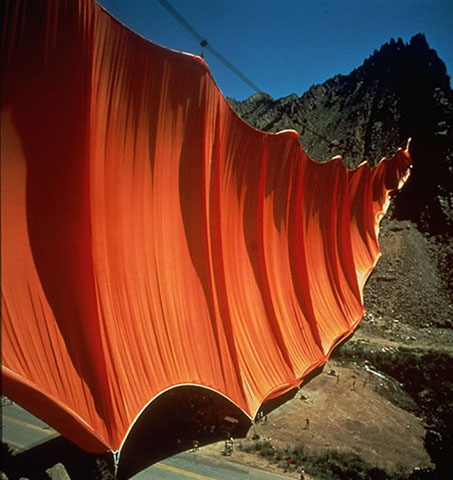
Valley Curtain by Christo and Jeane Claude. 1970-1972. What they do is refered to as "wrapping". Their website states,

Why wrapping?

Christo and Jeanne-Claude have done very few wrappings in comparison to their whole portfolio of artworks. Please notice how few of the works are wrappings, when you visit the index of Christo and Jeanne-Claude's photo collection.


It is easier for some to grasp the wrapping concept and refer to their artworks entirely as "wrapping", but the work is more about altering an environment than wrapping -- which is only one way to to that.

Thursday, November 6, 2008

In my opinion, what is earth art?

Earth art can be many things. Because of this, it feels hard to summarize. Taking a stab at in anyhow, I feel that earth art happens when people rearrange the environment around us for the sake of making a statement or to exercise their creativity. One of the purest ways to sculpt, I find it fascinating because it is sometimes may be understated or outstanding based on your perspective, and always respectful the land it occupies.